Corvallis/Salem/Eugene: (541) 250-6324
 info@calsmovinghelp.com


Interstate Moving on a Dedicated Truck, Priced from a Filed Tariff
Cal’s Moving & Storage moves households out of Oregon and Southwest Washington to anywhere in the lower 48. We are a registered interstate carrier with the Federal Motor Carrier Safety Administration, operating under our own USDOT authority and our own filed Interstate Tariff 100-A. That tariff is the reason your price is calculated from filed rates rather than invented at the kitchen table — and the reason we write it down after a survey instead of guessing at it on the phone.
Two things separate a Cal’s interstate move from the national van lines most people call first. The first is that your shipment travels on a truck dedicated to you, not consolidated with three other families and delivered inside a two-week window. The second is that we have crews in five Oregon locations and in Vancouver, Washington, which changes who actually shows up on load day — and that turns out to matter more than almost anything else on this page.
The Inter-Branch Advantage — and Why It Decides Your Move
Most interstate moves are handed off. Ours are not.
When you book a long-distance move with a national van line, you are usually booking a broker or an agent. A local agent in Oregon packs and loads you. A line driver you have never met takes the truck. A different agent’s crew — hired that morning, in a city you have never been to — unloads it. Nobody in that chain is accountable to the person who sold you the move, and the crew that carried your dresser down the stairs is not the crew that carries it back up.
Cal’s runs its own branches in Portland, Tigard, Salem, Corvallis and Eugene, plus Vancouver, Washington. Those are our employees, trained to the same standard, drawing from the same equipment pool. On an interstate move that means we can staff a load in one market with movers from another when a job is big or a date is tight, the same crew that loads your truck in Oregon is the crew that travels with it, and there is one company — ours — answering for the shipment from survey to final signature.
It also means we tell you the truth about our limits. We do not have branches in Denver or Boston. On a long haul our own crew travels with the truck and, where a destination genuinely needs extra hands, we hire and supervise local labor ourselves rather than subcontracting the delivery to an agent and losing sight of it.
How an Interstate Move with Cal’s Actually Runs
Survey — in person or live video
Someone from Cal’s walks your home, room by room, and builds a real inventory: cubic feet, heavy articles, what needs crating, stair and parking access at both ends. This is where the truck size and the honest price come from.
Written estimate and estimate type
You get the inventory, the tariff math, and your choice of binding, non-binding or not-to-exceed. You also choose your valuation level here, not at the door on moving day.
Booking — 10% deposit
The date goes on the board and a truck and crew are assigned to it. Long-distance dates in June through August go first; if you are moving in summer, book early.
Packing, if you want it
Full, partial or fragile-only. Our crews pack the TVs, glass and art whether or not you pack anything else, because that is what keeps your coverage valid. See packing assistance for carton pricing.
Load day with our own crew
A Cal’s crew — our employees — inventories, pads, wraps and loads. You sign a Bill of Lading listing the inventory, the valuation you chose, and the charges. Read it before you sign it.
Transit and delivery on your truck
Your shipment is the only shipment on that truck. We give you a delivery date rather than a window, and the same company that loaded you is the company that unloads you.
Routes We Run Most Often
Each route page below covers what that corridor actually involves — transit time, the passes and weather that affect it, and what to expect at both ends.
- Portland to SeattleAbout 175 miles up I-5. Short enough to load and deliver in a day. On a hop this short the tariff minimums, rather than the mileage, tend to drive the cost — which is worth understanding before you compare quotes.
- Portland to BoiseAbout 430 miles east on I-84 through the Columbia River Gorge. A common one-driver, next-day delivery. Winter moves over Cabbage Hill and Ladd Canyon need weather flexibility built into the date.
- Portland to San DiegoAbout 1,085 miles down I-5 through the Siskiyou Pass and the Central Valley. California is the single most common destination for Oregon households leaving the state.
- Portland to PhoenixAbout 1,330 miles via I-5 and I-10. Summer loads into Arizona get scheduled around heat — candles, electronics and anything with adhesive do not do well in a hot trailer.
Corridors beyond the named routes
Washington and the Pacific Northwest. Tacoma, Olympia, Bellingham and Spokane in addition to Seattle, and plenty of moves in the other direction into Oregon.
California. The Bay Area, Los Angeles, San Diego and Sacramento, all down the I-5 corridor.
Mountain West and Southwest. Boise, Salt Lake City, Denver, Las Vegas and Phoenix — I-84 and I-80 east, I-5 and I-10 south.
Texas and the Midwest. Austin, Dallas, Houston, Chicago and the Twin Cities. Multi-day transit with a published delivery date.
The East Coast. Boston, New York, Washington D.C., the Carolinas and Florida. These are the longest hauls we run and the ones where a dedicated truck is worth the most, because a consolidated shipment to the East Coast is where two-week delivery windows come from.
Binding, Non-Binding, or Not-to-Exceed — Your Choice on Interstate
This is one place where an interstate move gives you something an Oregon in-state move legally cannot. Oregon’s intrastate rules require every estimate we write inside the state to be non-binding. Federal rules for interstate moves allow three estimate types, and you pick:
- Binding. A fixed price for the inventory on the estimate. If the actual weight comes in higher or lower, the price does not move — but added items change the contract.
- Non-binding. An estimate of charges; you pay the actual tariff charges for what actually ships.
- Binding not-to-exceed. A ceiling. You pay the lower of the estimate or the actual charges. For most households this is the one worth asking about.
All three require a real survey. We write interstate estimates after an in-person walkthrough or a live video survey — never off a phone call or a web form, because an estimate built on a guess at your inventory is the single most common way long-distance moves go wrong.
Valuation Coverage: What Is Included, and What It Costs to Upgrade
Valuation is not insurance — it is the carrier’s level of liability for your goods, and federal law requires us to offer you a choice. Every interstate shipment includes the basic level at no charge. You can buy up.
Released Value — included, no charge
Liability of $0.60 per pound per article. A 40-pound television is covered at $24 regardless of what it cost. This is the default if you choose nothing, and for most households it is not enough.
Full Value Protection — priced by declared value and deductible
You declare the value of the shipment, and we repair, replace or settle for a damaged or lost item up to that amount. The rate depends on the deductible you accept:
| Deductible | Cost per $100 of declared value | Example: $60,000 declared |
|---|---|---|
| $0 | $2.00 | $1,200 |
| $250 | $1.50 | $900 |
| $500 | $1.10 | $660 |
| $1,000 | $0.90 | $540 |
Two limits you need to know before load day
Televisions, monitors, glass, mirrors, artwork and framed pictures must be boxed by our crews to be covered. If you pack those items yourself, or they travel unboxed, they move as Shipped at Your Own Risk and valuation does not apply to them. This is not a fine-print trap we spring at delivery — it is why we would rather sell you four TV cartons than argue about a cracked panel in Albuquerque.
Pressboard and ready-to-assemble furniture is capped at $0.60 per pound, maximum $128 per article, whatever valuation level you choose. Flat-pack furniture does not survive being disassembled, trucked 1,300 miles and reassembled, and no coverage level changes that.
Claims must be filed within 3 months of delivery.
What We Will Not Do
Being straight about this up front saves everyone a bad morning:
- Carry hazardous or flammable goods. Propane, gasoline, paint thinner, aerosols, ammunition, pool chemicals. Federal and state rules prohibit it and there is no exception we can make. Drain the mower and the grill before load day.
- Connect or disconnect appliances, water lines or gas. Our crews move the washer; a plumber or appliance tech does the hookup at both ends.
- Mount or dismount wall-hung televisions. We will box a TV that is already off the wall. We do not drill.
- Disassemble or reassemble a Sleep Number or similar adjustable bed. Those need a certified dealer technician or the warranty goes.
- Quote an interstate move over the phone. No survey, no estimate. A number given sight-unseen is a number that changes, and we would rather lose the booking than do that to you.
- Guarantee a date we cannot staff. If the week you want is full, we will tell you that instead of taking the deposit.
What Our Long-Distance Customers Say
I’ve moved 5 times (interstate) in the past 7 years and Cal’s Moving & Storage is the best company I’ve worked with. Justin, Anthony, Iain and Kraig were thoughtful, kind, hardworking, proactive, responsive and down to earth. These guys go above and beyond. Grateful I had the opportunity to work with them to pack, load and transport. They took great care of me and I’d highly recommend them to others looking for a positive team, excellent customer service, and fair pricing.
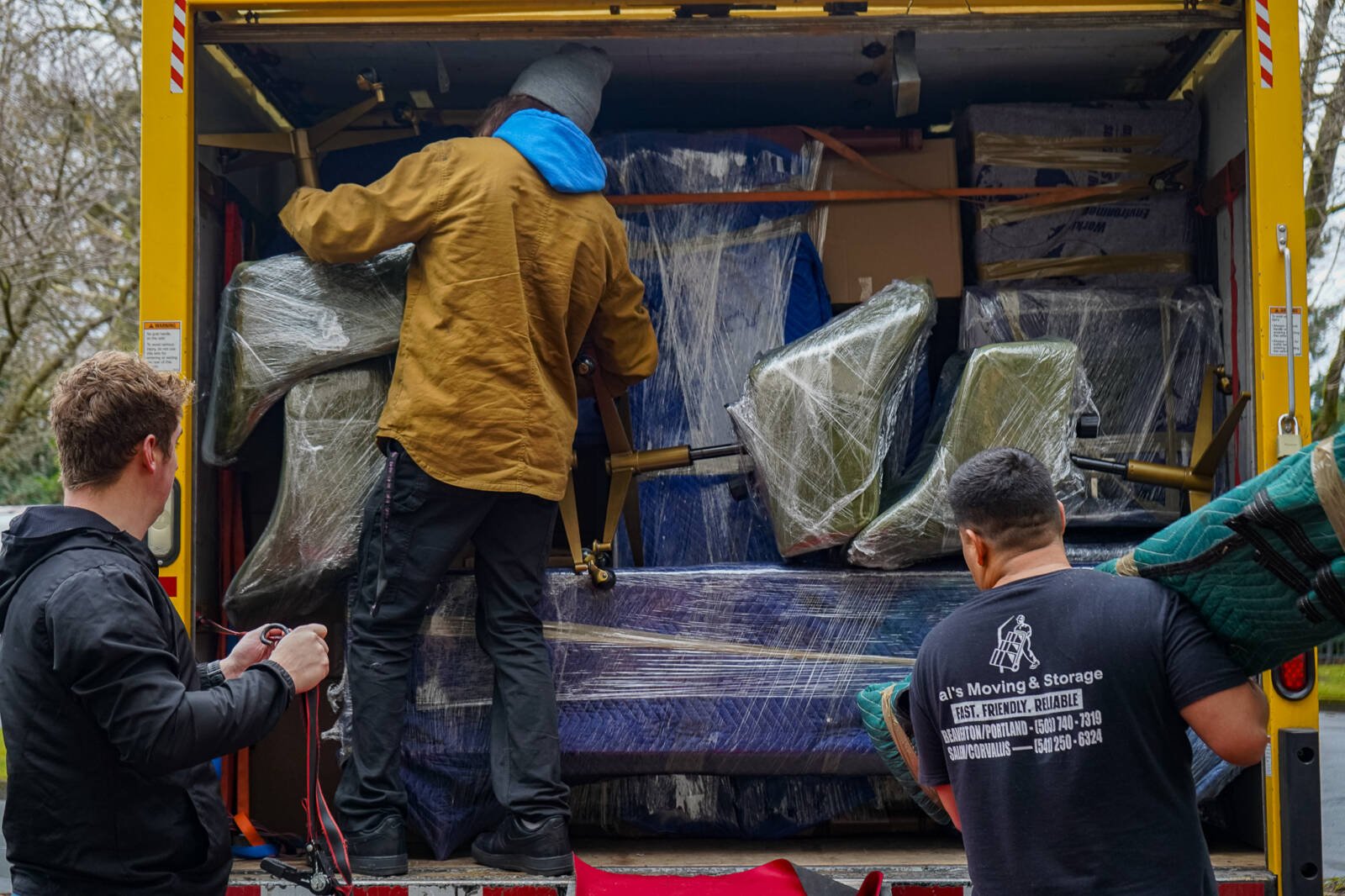
Gil and Justin were great. They were very helpful and informative and professional. They worked incredibly quickly and were very neat and organized, as the picture shows. I would definitely recommend this company!
Cal’s moving did a great job! They worked hard, were on-time, very courteous and friendly, and efficient. I highly recommend them for your next move. It saved me a lot of stress and worry. Thank you to Cal’s!
Frequently Asked Questions About Long-Distance Moving
How much does a long-distance move from Oregon cost?
Unlike a local move, which is simply an hourly rate, an interstate move is priced from several moving parts: the distance, the size of truck your shipment actually needs, a fuel surcharge that tracks diesel, and any packing labor and materials. Tariff minimums also apply, which matters most on shorter interstate hops. That is why we will not put a number on it until someone has walked your home in person or on live video — with that inventory in hand we build the figure from our filed Interstate Tariff 100-A and put it in writing, with your choice of a binding, non-binding or not-to-exceed estimate.
Is my shipment on its own truck or combined with other families?
Its own truck. We run dedicated interstate service, which is why we can give you a delivery date rather than a multi-day or multi-week window. Consolidated shipping is cheaper per pound and it is how most national van lines operate, but it is also where delivery windows and repeated handling come from.
Can you give me a binding price?
Yes, on interstate moves. Federal rules allow binding, non-binding and binding not-to-exceed estimates and you choose which one you want. This is different from a move inside Oregon, where state rules require every estimate to be non-binding. All three require an in-person or live video survey first.
Will you quote my move over the phone?
No. Every interstate estimate we write follows an in-person walkthrough or a live video survey, because truck size, crew size and price all depend on a real inventory. A number given sight-unseen is the most common reason long-distance moves end in a dispute.
What valuation coverage do I get, and what does more cost?
Released Value at $0.60 per pound per article is included at no charge. Full Value Protection is priced per $100 of the value you declare: $2.00 with no deductible, $1.50 with a $250 deductible, $1.10 with $500 and $0.90 with $1,000. On a $60,000 declared value that is $1,200 down to $540. Televisions, monitors, glass, mirrors and artwork must be boxed by our crews to be covered, and pressboard furniture is capped at $0.60 per pound, maximum $128 per article, at every level.
How far ahead should I book?
For a June, July or August move, as far ahead as you can, because those dates fill first and a dedicated truck committed to one household is a date we cannot double-book. A 10% deposit holds a long-distance date. Off-season moves have more flexibility, but a survey still has to happen before we can write the estimate.
How long will my shipment be in transit?
Roughly 500 to 600 miles of driving per day on a single-driver run, so Boise is typically next-day, California two to three days, Texas three to four, and the East Coast five to seven. Because the truck is yours, we commit to a date rather than a window, and weather over the Siskiyous, Cabbage Hill or the Rockies is the one thing that can move it.
What cannot go on the truck?
Anything hazardous or flammable: propane, gasoline, paint thinner, aerosols, ammunition, pool chemicals. Federal and state rules prohibit it. Drain fuel from mowers and remove propane tanks from grills before load day. We also do not connect appliances or gas and water lines, do not mount or dismount wall-hung televisions, and cannot take apart a Sleep Number bed, which needs a certified dealer.
Are you actually licensed for interstate moves?
Yes. Cal’s Moving & Storage is registered with the Federal Motor Carrier Safety Administration under our own USDOT number, with cargo insurance, liability coverage and workers’ compensation. Our operating authority and safety record are public and searchable in the FMCSA database. Any company moving household goods across state lines is required by federal law to hold that authority, and a surprising number of the companies advertising long-distance moves are brokers who hold none of it and subcontract your shipment to whoever bids lowest.
Get a Real Long-Distance Estimate
Book a survey — in your home or over live video — and we will build the inventory, run the tariff math and put your choice of binding, non-binding or not-to-exceed in writing.