 Corvallis/Salem/Eugene: (541) 250-6324
 info@calsmovinghelp.com


Long-distance moving is a regulated industry, but it still attracts bad actors every year. Thousands of families lose money, have belongings held hostage, or arrive at their new home to find a fraction of what was picked up. It almost always comes down to the same pattern: someone hired an unlicensed operator based on a low phone quote, and the price climbed — or the truck disappeared — only after the load was on board.
This 2026 guide covers how to tell legitimate long-distance movers from scam operations, the specific federal licensing you should verify before signing anything, the red flags that should end a conversation immediately, and the questions every honest carrier should be willing to answer in writing. At Cal’s Moving & Storage, we’re a fully licensed interstate carrier (USDOT registered), IOMI® Certified for office moves, BBB accredited, and 4.9-star rated across 2,300+ moves — and we’d rather help you know what to look for than have you learn these lessons the hard way.
Prefer to talk? Call (503) 746-7319 — we answer live during business hours.
★ 4.9 Google Rating · 2,300+ Reviews · BBB Accredited · USDOT Licensed · IOMI® Certified
Talk to a Pro!









🛡️ Quick Facts: Long-Distance Moving Regulation (2026)
| Federal regulator | FMCSA (Federal Motor Carrier Safety Administration) |
| License numbers to verify | USDOT Number + MC (Motor Carrier) Number |
| Where to verify | protectyourmove.gov · fmcsa.dot.gov SAFER System |
| Required paperwork | Written estimate + Bill of Lading (mandatory) |
| Default valuation coverage | Released Value: 60¢/lb per item (free, inadequate) |
| Upgraded coverage | Full Value Protection: 1–3% of declared value |
| Cal’s Moving credentials | USDOT licensed · IOMI® Certified · BBB Accredited (2022) |
Start With FMCSA License Verification

Every legitimate interstate moving company in the United States is required to register with the Federal Motor Carrier Safety Administration (FMCSA). Registration produces two public numbers: a USDOT number and a Motor Carrier (MC) number. These numbers are searchable in two free government databases:
protectyourmove.gov — the FMCSA’s public-facing consumer tool. Enter a company name or USDOT number and you’ll see whether the company is licensed, whether their authority is active, how long they’ve been registered, and their complaint history.
fmcsa.dot.gov SAFER System — deeper operational data, including insurance status, safety ratings, and audit history.
Ask every long-distance mover you’re considering for their USDOT and MC numbers. Verify them before you sign anything. Any company that hesitates, refuses, or can’t provide them is unlicensed — end of conversation.
The Carrier vs. Broker Distinction (And Why It Matters)
This is the single most misunderstood thing about interstate moving, and it’s where most scams originate.
A carrier is a moving company that operates its own trucks, warehouses, and crews. They’re directly responsible for your load from pickup through delivery. If something goes wrong, you have a clear party to hold accountable. Cal’s Moving is a carrier.
A broker doesn’t own trucks or hire movers. They collect your information, quote you a price, take a deposit, and then sell your job to the lowest-bidding carrier — often one you’ve never heard of and can’t verify. Many fraudulent operations pose as “moving companies” but are actually brokers. Legitimate brokers exist, but the business model creates accountability gaps that dishonest operators exploit.
Federal regulations require brokers to disclose their broker status, but enforcement is spotty. Ask every company you contact: “Are you a carrier or a broker? Will the truck that picks up my belongings be operated by you or sold to another company?” If the answer is anything other than a clear, immediate “We’re a carrier and our trucks do the entire move,” dig deeper before committing.
Red Flags That Should End the Conversation
Rule out any long-distance mover showing any of these signs. These aren’t “warning indicators” — they’re near-certain markers of a scam or a near-scam operation.
No physical address or warehouse. Every legitimate interstate carrier has a real facility. A mover with only a PO box, a virtual office, or an address that turns out to be a residential home is almost always a broker or fraudulent operation without operational capacity.
Cash-only or large deposits upfront. Reputable movers bill on delivery or take a small deposit (10% maximum). “Cash-only” or “50% upfront” requests are the mechanism by which the “disappearing truck” scam works — they collect the money and never show up, or they arrive and then demand more cash to release your belongings.
No USDOT number visible. Federal law requires interstate carriers to display their DOT number on their trucks and in advertising. A mover whose website, proposal, or truck lacks that number is unlicensed, operating illegally, or both.
Quotes that don’t require an inventory. A real binding estimate requires a survey (video walk-through or on-site visit) of your actual household. Pricing by phone in under five minutes, based on a rough room count, is how hostage-load scams start. The mover lowballs you to win the job, then “discovers” your load weighs more than quoted at destination and demands massive additional fees to release it.
Vague or missing paperwork. Every interstate move requires a written estimate and a Bill of Lading. If either is verbal, incomplete, or missing specific numbers for weight, services, and total cost, walk away. You’re looking at a company that plans to invent charges later.
Pressure to sign a blank contract. Some scam operations will ask you to sign a Bill of Lading with blanks to “fill in later.” Never do this. A blank Bill of Lading is a signed license to bill you whatever they want.
Where We’ve Moved Oregonians
Over 500 interstate moves completed
From next door to across the country — Cal’s has you covered.
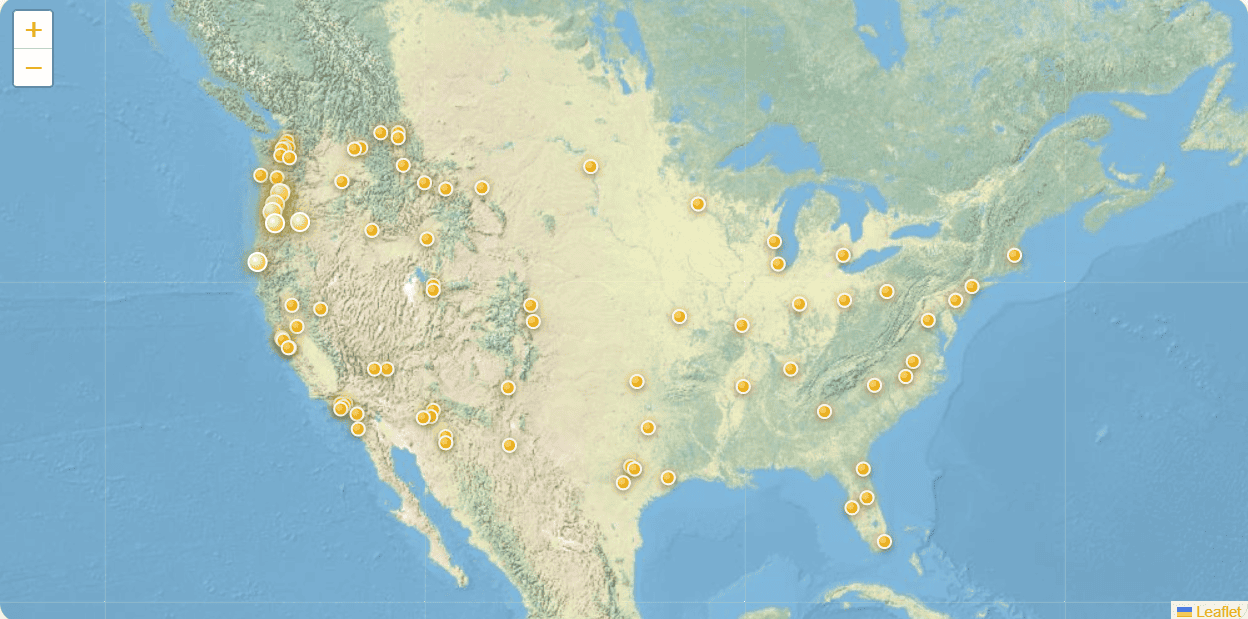
Popular Long Distance Routes from Oregon
Oregon to Seattle and the Pacific Northwest
The I-5 corridor connecting Oregon to Washington is our most frequently traveled long distance route. Portland to Seattle at roughly 175 miles can often be completed in a single day with same-day loading and delivery. We also handle moves from across Oregon to Tacoma, Olympia, Bellingham, Spokane, and other Washington destinations, as well as moves to and from Portland along this busy corridor.
Oregon to California
California is the single most common out-of-state destination for Oregon movers, with the San Francisco Bay Area, Los Angeles, San Diego, and Sacramento being the top destinations. The I-5 route south through the Willamette Valley, over the Siskiyou Pass, and through the Central Valley is the primary corridor. We are familiar with California’s moving regulations and ensure full compliance for a smooth delivery. Moves to Southern California typically take one to two days in transit.
Oregon to Boise and the Mountain West
The I-84 corridor through the Columbia River Gorge and across eastern Oregon is the gateway to Boise, Salt Lake City, Denver, and the Mountain West. Oregon to Boise is approximately 430 miles and is a popular retirement and relocation destination. These moves typically take one to three days in transit, and we coordinate timing carefully to accommodate altitude changes and seasonal mountain conditions that can affect scheduling.
Oregon to the Midwest and East Coast
Cross-country moves from Oregon to states like Texas, Colorado, Illinois, Florida, New York, and beyond require careful planning and experienced handling. These long-haul relocations cover thousands of miles and three to seven days of transit time. Our team has completed hundreds of these cross-country moves and knows exactly how to protect your belongings over the distance. We provide detailed delivery windows so you can plan your arrival and coordinate housing, utilities, and other logistics at your new destination.
Moves to Oregon
We also handle inbound long distance moves for people relocating to Oregon from other states. If you are moving to Oregon for work, family, or lifestyle reasons, we can coordinate pickup at your current home and delivery to your new Oregon address. Inbound moves follow the same dedicated-truck, binding-estimate process as outbound moves.
💡 Pro Tip: Get the USDOT and MC numbers in writing before you pay a deposit, not just verbally over the phone. Copy them from the company’s written estimate, not from what the salesperson says during the call. Scam operations often have fake or borrowed numbers that they’ll cite verbally but won’t put on paper. The five minutes it takes to verify at protectyourmove.gov has saved plenty of households a cross-country nightmare.
Binding vs. Non-Binding Estimates — Know the Difference
Federal law allows both types of estimates for interstate moves, but only one actually protects you.
Binding estimate. The mover commits to a specific price in writing based on your inventory. That price is locked in. The only way it can legitimately increase is if you add services or items on moving day that weren’t in the original inventory.
Non-binding estimate. The mover quotes a “ballpark” that can change. Federal law limits how much the final bill can exceed a non-binding estimate at delivery (110% required payment, the rest later), but in practice non-binding estimates are frequently weaponized as bait-and-switch. The low quote gets the job; the higher real bill arrives with the truck.
Rule: ask every mover for a binding written estimate. If they only offer non-binding, keep looking. Every legitimate mover can and does provide binding estimates for interstate moves. Cal’s Moving provides binding estimates on every long-distance quote, no exceptions.
What a Legitimate Moving Quote Should Include
When you compare long-distance quotes, the real comparison isn’t just the dollar amount — it’s whether each quote actually includes the necessary specifics. A legitimate binding written estimate should always include:
- A detailed inventory — every room, every piece of furniture, every specialty item.
- A specific pickup and delivery window — not just “sometime in June.”
- Line-item service descriptions — packing, crating, vehicle transport, storage-in-transit, stairs/elevators, anything that adds cost.
- Valuation coverage type and cost — released value (default, free, inadequate) vs. full value protection (premium, typically 1–3% of declared value).
- The mover’s USDOT and MC numbers.
- Total binding price.
- Payment terms — when deposits are due, what forms of payment are accepted, final balance timing.
Any quote missing one or more of these items isn’t really a binding quote, regardless of what the paperwork calls itself.
Want to see what a complete, federally-compliant long-distance quote looks like?
Call (503) 746-7319 or request a free quote online — we’ll walk you through every line item with USDOT and MC numbers on the paperwork.
The Bill of Lading — Your Contract With the Mover
The Bill of Lading (BOL) is the contract between you and the mover. Federal law requires one on every interstate move. It’s the document that governs who is responsible for what, how pricing is enforced, and how any damage claim will be evaluated. Among other things, your BOL should specify:
- Your pickup and delivery addresses and dates.
- The binding or non-binding price and services.
- Valuation coverage level you’ve elected.
- An inventory listing (often as a separate attached document).
- Your rights and the mover’s obligations under federal regulation.
Read the Bill of Lading before you sign. Never sign a blank or partially-completed Bill of Lading, regardless of who’s asking. Keep a copy for your records — you’ll need it if you ever have a damage claim or dispute.
💡 Pro Tip: The FMCSA’s free consumer guide “Your Rights and Responsibilities When You Move” is required reading before any interstate move. Any legitimate carrier will provide you a copy of this booklet; if they don’t, ask for it, or download it yourself from protectyourmove.gov. It spells out exactly what rights you have under federal law — most of which scam operators hope you never learn.
How to Check a Mover’s Reputation
Licensing verifies legitimacy. Reputation verifies quality. Before signing with any long-distance mover, check at least three of the following sources:
Better Business Bureau (BBB). Look for accreditation status, letter grade, and customer complaints. Accredited BBB businesses have a financial and reputational stake in resolving disputes.
Google reviews. Volume and recency matter. A company with 1,000+ reviews averaging 4.5 stars tells a different story than one with 30 reviews averaging 4.9 stars. Look at the 1- and 2-star reviews specifically — patterns in the complaints reveal how the company actually handles problems.
Yelp and Angi. Different user bases, different review patterns. Complement Google.
FMCSA complaint database. The government’s own record of consumer complaints filed against specific interstate movers, searchable at protectyourmove.gov. A few complaints over many years is normal for any operating carrier; dozens in a short window is a screaming alarm.
Social proof in person. Real estate agents, property managers, corporate HR coordinators, and friends who’ve recently relocated are often the best source of referrals. Ask them who they’ve actually used, not just who they’ve heard of.
Why Licensed Oregon Movers Are Worth More Than the Price Gap
When you compare binding quotes, there’s almost always a cheap option that’s several hundred dollars below a reputable licensed mover. The gap isn’t arbitrary — it reflects real costs the cheap option isn’t bearing: federal licensing, cargo insurance, workers’ compensation coverage, background-checked crew, uniformed staff, maintained fleet, and the accountability of a company that plans to still be in business next year.
Cal’s Moving & Storage carries every one of those costs as a fully licensed Oregon interstate carrier. That’s why we can offer a binding estimate that actually binds, answer your damage claims through our office rather than vanishing, and run 500+ successful interstate moves across the continental U.S. It’s also why our pricing won’t be the cheapest quote you receive — but it’ll be honest, predictable, and backed by a real company with a real address.
If you’re getting quotes for a long-distance move from Oregon, we’re happy to show you our USDOT registration, BBB accreditation, IOMI® Office Mover certification, and 2,300+ customer reviews before you decide. And if you go with somebody else who can show you the same documentation, we consider that a good outcome too — the goal here is that you don’t end up on the wrong end of a scam.
Frequently Asked Questions
Is it worth paying more for a licensed interstate mover?
Almost always, yes. The price gap between a licensed carrier and the cheapest quote is typically 10–25% on a long-distance move. The potential cost of a hostage-load scam, missing belongings, or uninsured damage is 10–100x that gap. The math favors the licensed option. Call (503) 746-7319 to see what a transparent binding quote looks like.
What if something gets damaged during my long-distance move?
With a licensed carrier and full value protection coverage, you file a damage claim through the mover’s claims process. The mover either repairs, replaces, or reimburses the cash value of the item. With released value (the free default) you’re limited to 60¢ per pound per item. If the mover is unlicensed or a disappeared broker, your options are usually small claims court or your insurance company. Full value protection is an option on every Cal’s Moving interstate quote — request yours here.
Can I report a moving scam after the fact?
Yes. File an FMCSA complaint at protectyourmove.gov, a BBB complaint if the company is accredited, and a police report if criminal fraud occurred (hostage load, missing items, etc.). In cases of interstate hostage loads, the FBI sometimes gets involved. The state attorney general’s consumer protection office is also worth contacting.
How do I know if the quote I’m getting is realistic?
Get three binding quotes from three licensed carriers. If one is significantly lower than the other two, it’s almost always a bait-and-switch. Legitimate binding estimates from three licensed carriers on the same inventory and route typically fall within 15% of each other.
Should I verify my mover’s insurance?
Yes. Ask the mover for proof of their cargo insurance coverage and workers’ compensation. A real carrier can produce both certificates on request. Uninsured movers carry the risk on you — if something goes wrong, your options are limited.


Run Cal’s Moving Through Your Own Checklist
Everything this guide warns against — cash-only deposits, missing USDOT numbers, vague estimates, blank Bills of Lading, broker middlemen — you’ll find none of on any quote from us. Before you decide, ask us to show you:
- Our live USDOT registration on protectyourmove.gov
- Our BBB accreditation and letter grade
- A sample binding written estimate so you can see the line items
- Our cargo insurance and workers’ comp certificates
Call (503) 746-7319 or request a free quote — we’ll lay it all out.
Need a Trustworthy Long-Distance Mover in Oregon?
Cal’s Moving & Storage is a fully licensed Oregon interstate carrier with 500+ completed interstate moves, 10,000+ total moves, 2,300+ reviews averaging 4.9 stars, BBB accreditation since 2022, and IOMI® Office Mover certification. Every long-distance quote comes with binding pricing, a written estimate, a Bill of Lading, and full transparency about what your price covers.
If you’re moving out of Oregon and looking for a carrier who will tell you honestly what your move should cost — and will stick to that number — we’re glad to help. Call us at (503) 746-7319 for Portland Metro or (541) 250-6324 for Salem, Corvallis, and Eugene, email info@calsmovinghelp.com, or request your free quote online.
Quick Quote
Related Moving Resources
More guides for planning a safe, informed long-distance move:
- Long Distance Moving Cost from Oregon: 2026 Pricing Guide — Real price ranges and what drives your bill.
- Long Distance Movers in Oregon — Service overview and interstate licensing.
- Moving to Washington from Oregon
- Moving to Idaho from Oregon
- Moving to Texas from Oregon
- Moving to Arizona from Oregon
- Customer Reviews — 4.9-star-rated across 2,300+ completed moves.